
Research
Analysis of Sex Differences in Cardiometabolism and Gene Regulation
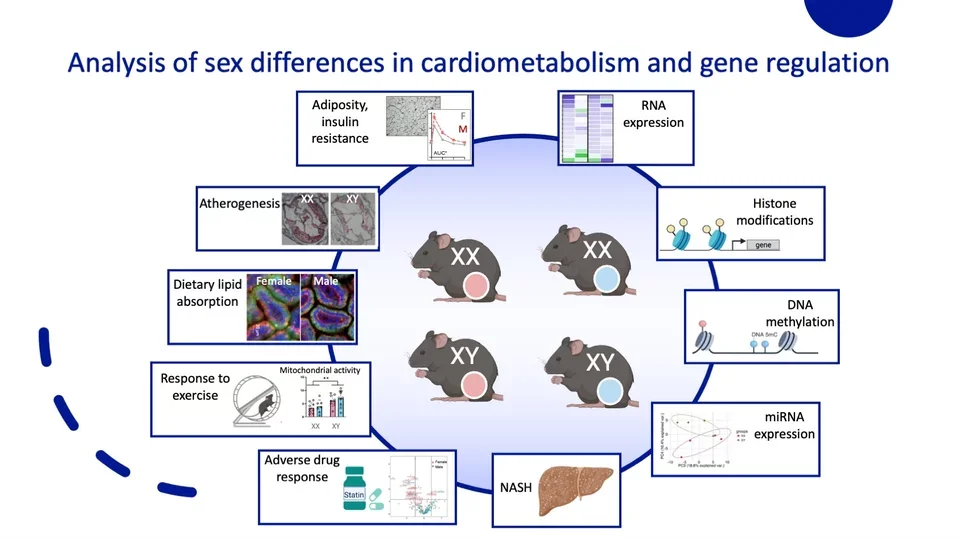
The Reue Lab investigates the genetic and molecular mechanisms that underlie sex differences in cardiometabolic health and disease. Biological differences between females and males arise from both gonadal hormones and sex chromosome complement. We use the Four Core Genotypes mouse model, together with genetic, genomic, cellular, and metabolic approaches, to distinguish the independent contributions of these factors.
Our research has revealed roles for sex chromosome complement in adiposity, atherosclerosis, lipid metabolism, mitochondrial function, gene regulation, and response to commonly used medications. A major focus of our current work is understanding how X chromosome gene dosage and genes that escape X chromosome inactivation influence metabolic and cardiovascular phenotypes.
Current studies span obesity and adipose biology, liver disease, atherosclerosis, pharmacogenomics, mitochondrial metabolism, dietary lipid handling, and epigenetic regulation.
X Chromosome Dosage, Obesity, and Adipose Biology
Women and men differ in the amount, distribution, and metabolic properties of adipose tissue. Although gonadal hormones contribute to these differences, our studies have demonstrated an independent role for sex chromosome complement.
Using the Four Core Genotypes model, we found that the presence of two X chromosomes promotes increased adiposity compared with one X chromosome. We subsequently identified the X chromosome escape gene Kdm5c, which is expressed at higher levels in XX cells, as an important contributor to this effect.
KDM5C is a histone demethylase that influences chromatin and gene expression. Our current studies investigate how KDM5C dosage and activity regulate adipocyte development, white and brown adipose tissue function, mitochondrial metabolism, and whole-body energy balance.
Sex Differences in MASH
Metabolic dysfunction-associated steatotic liver disease (MASLD) and its progressive inflammatory form, metabolic dysfunction-associated steatohepatitis (MASH), exhibit important differences between females and males. These differences may arise from the effects of gonadal hormones as well as genetic differences associated with XX and XY sex chromosome complement.
Current studies use the Four Core Genotypes model to distinguish the contributions of gonadal and chromosomal sex to the development and progression of metabolic liver disease. We are investigating how these sex components influence hepatic steatosis, inflammation, fibrosis, and the molecular pathways that drive progression to MASH.
Sex Differences in Atherosclerosis and Vascular Biology
Atherosclerotic cardiovascular disease differs between women and men in plaque burden, cellular composition, and clinical presentation. Our laboratory investigates how gonadal sex and sex chromosome complement independently influence atherosclerotic plaque development and composition.
We are defining sex-specific changes in vascular cell states within the atherosclerotic vessel wall and their role in plaque phenotype. By integrating experimental models with genomic and human vascular data, we aim to identify mechanisms that contribute to sex differences in cardiovascular disease.
Sex Differences in Statin Response
Statins are highly effective medications for lowering cholesterol and preventing cardiovascular disease, but some individuals develop adverse effects including muscle symptoms and impaired glucose homeostasis. Women appear to be particularly susceptible to some of these effects.
Our laboratory discovered that X chromosome dosage influences susceptibility to statin-induced metabolic dysfunction. Reducing X chromosome dosage, or the X chromosome escape gene KDM5C, protects against several adverse metabolic effects of statin treatment, implicating sex chromosome gene dosage as an important determinant of drug response. Current studies are investigating the molecular mechanisms through which KDM5C regulates statin response. These studies aim to uncover mechanisms that may ultimately enable more individualized approaches to lipid-lowering treatment.
Dietary and Postprandial Lipid Metabolism
The metabolic response to dietary fat differs between females and males. Following a fat-rich meal, triglyceride-rich lipoproteins enter the circulation and are accompanied by metabolic and inflammatory responses that can influence long-term cardiovascular risk.
Our studies focus on distinct roles for gonadal and chromosomal sex in regulating postprandial lipid metabolism and inflammation. We investigate the sex differences in intestinal lipid absorption, postprandial triglycerides, inflammatory responses, and lipid metabolism.
Lipin Proteins and Lipid Metabolism
The Reue Laboratory discovered the lipin gene family through studies of a mouse model of lipodystrophy. Lipin proteins have since emerged as important regulators of lipid synthesis, energy metabolism, and gene regulation.